
CT College of Technology and MET2 Cohort Presentations

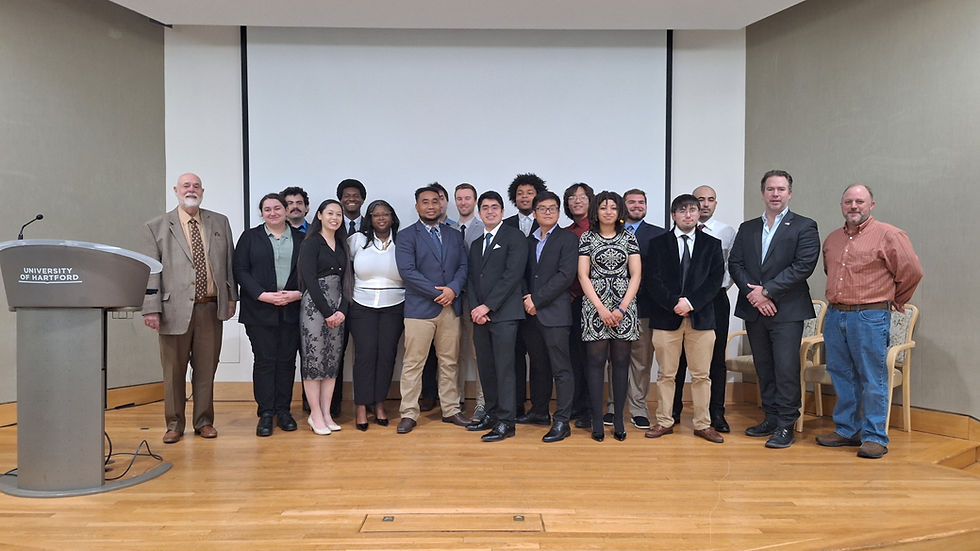
The National Science Foundation funded National Center for Next Generation Manufacturing sponsored the latest Connecticut College of Technology meeting, held at the University of Hartford on Friday, April 17th, 2026. This meeting offered the 2026 Mechanical Engineering Technologies & Manufacturing Engineering Technologies (MET2) cohort an opportunity to showcase their project progress. The University of Hartford kindly arranged a tour of the campus's manufacturing and engineering labs. Additionally, the 2026 NASA CT Space Grant Consortium Community College Drone Challenge was held at the university, allowing meeting participants to watch the challenge live from their conference room.

Key Agenda Items
The College of Technology convened to address several key agenda items that are pertinent to the ongoing development and enhancement of educational programs within the state. A significant focus of the meeting was a discussion surrounding the federal workforce Pell grant initiative. This initiative is designed to provide financial assistance to students pursuing career technical education, particularly in fields that align with workforce demands.
During the meeting, participants examined the implications of the Pell grant initiative for Connecticut institutions. Specifically, they discussed how it could affect enrollment, program offerings, and overall institutional funding. The discussion highlighted the potential benefits that the initiative could bring to students who may face financial barriers to accessing higher education. The outcomes of these discussions are expected to shape future policies and initiatives aimed at fostering an educational environment that meets the needs of both students and employers alike.
Student Presentations
The following information details the presentations by College of Technology students, both from Connecticut State Community College and from four-year institutions. One of the College of Technology's upcoming initiatives is to expand its reach to other partners in Connecticut and neighboring states.

Team Maker Motion
Members:
Anders Maxilus, CT State Community College Gateway
Latosha Murray, CT State Community College Gateway
Jeannie Tran, CT State Community College Gateway
Hanif Barrett, CT State Community College Middlesex
The Maker Motion project, sponsored by the Northwest Connecticut Housing and Innovation Center (NCHIC), aims to design and develop a mobile cobot pedestal system for the Revopoint Vbot 3D scanning platform. This system will be used for demonstration, training, and practical applications. The project involves integrating a commercially available 80/20 pedestal structure with a custom-designed mounting interface. This will securely support the scanner while maintaining stability, mobility, and ease of use.
The team is responsible for assessing structural requirements, creating CAD models, selecting materials, and producing a functional mounting solution that meets both technical and practical needs. This project provides hands-on, application-driven engineering experience that emphasizes real-world system integration over theoretical design.
This project enhanced engineering judgment by requiring consideration of fabrication, assembly, and system integration constraints throughout the design process. Decisions were assessed not just for theoretical performance but also for constructability and real-world implementation. Additionally, the project emphasized the importance of clear communication, thorough documentation, and iterative development when collaborating with a team and a project sponsor.
Team UpTime
Members:
Michael Miranda, University of New Haven
Alexander Valdivia, CT State Community College Gateway
Victor Paez, CT State Community College Gateway
Ibraheem Rana, CT State Community College Manchester
Uptime set out to create a machine learning algorithm to classify and predict the remaining lifespans of CNC bits. The team used machine learning programs to analyze the data collected. This allows for precise and accurate estimates on the parts, indicating how certain processes or materials could further degrade or extend lifespan.
The purpose of this program is to allow for accurate predictions of needed maintenance before the problem occurs, thus removing maintenance downtime. Uptime created a variety of programs to achieve this, going through several algorithms and iterations, all in the hopes of creating maintenance Uptime.
Team MEK Additive Manufacturing
Members:
Kenyce Johnson, University of Bridgeport
Emma Dargenio, University of Hartford
Matthew Lynch, University of Hartford
The objective of this project is to go from a 3D scan of a physical pipe, create a 3D model of the pipe, and complete an FEA analysis and a flow simulation of the pipe's 3D model. With the results of the FEA and the flow simulation, the team aims to create a more organic model of the pipe that will be 3D printed. This will help identify potential efficiencies in both the pipe design and the documentation of the part details. By 3D-printing the pipe, the team is looking to reduce manufacturing time while maintaining part complexity.
Team BEEZ KNEEZ
Members:
Alissa Pace, Central Connecticut State University
Jahmal Bynum, Central Connecticut State University
Dang Ly, University of Connecticut
Justin Tran, Central Connecticut State University
This project aims to develop a robotic assistant that can serve food to individuals with disabilities. The team will utilize 3D modeling and printing for the external components of this robot. They will also develop an ESP32 microcontroller along with various sensors, including infrared, inertial measurement unit (IMU), and ultrasonic sensors. These components will be programmed to allow the robot to act autonomously.
The project consists of two main parts: the modified mini fridge and the mobile robot. The modified mini fridge will respond to input for a selected meal and will release the meal container for the mobile robot to retrieve. The mobile robot will then deliver the meal first to the microwave (located on top of the mini fridge) and then to the table.
Team Motion Forms
Members:
Diego Angeles, CT State Community College
Thomas Roberts, University of Connecticut
Jacob McCann, Central Connecticut State University
The project focused on designing and assembling a reliable system to consistently transmit power from a servo motor to an abrasive polishing disk for a research initiative at Central Connecticut State University. The primary goal was to engineer and optimize a servo-driven power transmission system that minimizes vibration from external sources. This ensures smoother operation and improved precision.
This work supports the broader objective of developing a fully autonomous robotic arm capable of manufacturing aircraft turbine blades. Consistency and accuracy are critical to reducing the number of defective or scrapped parts, which helps reduce cost and time spent machining.
The National Center for Next Generation Manufacturing would like to acknowledge all of the partner universities and Connecticut State Community College for their support of the MET2 program.


Comments