
MET² 2026 Cohort

Updated: Jan 27
The National Science Foundation (NSF) funded National Center for Next Generation Manufacturing has officially commenced the highly anticipated 2026 Mechanical & Manufacturing Engineering Technologies (MET²) Program cohort. This exciting initiative began with a two-week Winter Intersession Workshop hosted this year by Central Connecticut State University.
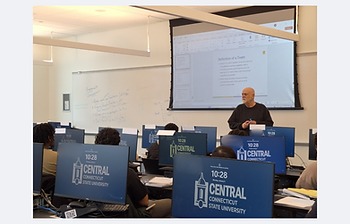
This innovative program provides comprehensive instruction in technical and professional skills for community college and university students. After the Winter Intersession Workshop, participants will work in teams on industry-led research projects, applying skills learned in the Winter Intersession Workshop and their college coursework.

The MET² program curriculum encompasses a diverse range of lessons and practical experiences that are applicable in industry and their research projects. Students gain hands-on experience in Computer-Aided Design (CAD) using SolidWorks software, enabling them to create detailed engineering drawings and models. Blueprint Reading is another component of the training, enabling students to interpret and understand technical drawings accurately. The program also includes AC and DC Circuit Analysis, a critical subject for those pursuing careers in electrical engineering and manufacturing.

The MET² program introduces students to cutting-edge topics, such as micro: bit programming, enabling them to explore embedded systems and coding. An overview of artificial intelligence and cybersecurity will also be provided, ensuring that students are well-versed in the latest technological advancements and the importance of safeguarding digital information.

In addition to these technical subjects, the program emphasizes employability and social skills. Students will learn about the DISC Behavior Model, which is instrumental in understanding interpersonal dynamics and enhancing team collaboration. They also learn teamwork strategies, the art of power networking, and how to plan projects effectively, all essential skills in today’s competitive job market. The curriculum also covers Emotional Intelligence (EQ), which is increasingly recognized as a key factor in successful leadership and teamwork. Students will also learn to navigate interpersonal challenges by mastering techniques for dealing with difficult people, a skill crucial in any collaborative environment. To round out their employability skills , participants will receive training in time management techniques, equipping them with the tools necessary to balance their academic responsibilities and project commitments effectively.

We are excited as the students prepare to begin researching and developing their innovative projects during the intensive two-week session. This hands-on experience will not only solidify their learning but also showcase their creativity and problem-solving abilities. We eagerly anticipate the opportunity to present their research and prototypes during the upcoming spring semester, when the culmination of their efforts will be shared with peers, faculty, and industry leaders, underscoring the importance of education in advancing mechanical and manufacturing technologies.

The following are descriptions of the MET² 2026 Cohort Projects
3D Scanning & Cobot Mobile Pedestal
Sponsored by: Steve Longpre, Director of Technology & Programming, Northwest Connecticut Housing and Innovation Center
The student team will design and build a lower cost mobile, lockable pedestal and mounting plate that enables a cobot to have a safe, full range of motion for 3D scanning and related applications. Students will utilize advanced manufacturing technologies and processes that can be replicated in educational and industry settings. The team will install a Revopoint Trackit 3D Scanning System onto the cobot and demonstrate its use. Drawings, CAD files, a Bill of Materials, and assembly and installation instructions will be produced.

Team Members
Anju Chinkoe, CT State Community College Naugatuck Valley Anders Maxilus, CT State Community College Gateway
Latosha Murray, CT State Community College Gateway Jeannie Tran, CT State Community College Gateway
Hanif Barrrett, CT State Community College Middlesex
Component Optimization using Simulations and Additive Manufacturing
Sponsored by: Sean Belleau, Client Executive, TRIMECH
The student team will design and optimize a component using CAD software, computational fluid dynamics (CFD), and finite element analysis (FEA). The part will be evaluated under realistic aerodynamic and structural loading conditions to improve performance and efficiency. Based on these simulations, the component is refined to achieve an optimized design before physical prototyping in plastic then metal. The project demonstrates how simulation-driven design enables manufacturers to reduce physical testing cycles, lower development costs, and improve performance prior to manufacturing. By combining digital analysis with additive manufacturing, the team illustrates a modern aerospace engineering workflow that integrates design, simulation, and advanced manufacturing technologies.

Team Members
Kenyce Johnson, University of Bridgeport Emma Dargenio, University of Hartford Matthew Lynch, University of Hartford
Robotic Arm Station
Developed by: Dr. Haoyu Wang, Professor, Central Connecticut State University
The student team will work with the robotics lab at Central Connecticut State University to design a robotic assembly. The project will begin with testing forces seen during system operation and determining the appropriate components, mounting devices, and housing needed to ensure safe and efficient operation. The team will design, fabricate, and assemble a prototype of the entire assembly and housing.

Team Members
Diego Angeles, CT State Community College,0 Manchester Thomas Roberts, University of Connecticut
Jacob McCann, Central Connecticut State University (not pictured)
Using Artificial Intelligence for Predictive Maintenance
Developed by: Eric Flynn, Professor CT State Community College Gateway
This project will use AI-based systems to simulate predictive maintenance on a CNC machine. By analyzing sensor data, the AI model identifies patterns that may indicate tool wear or impending machine failure. The simulation demonstrates how AI can be applied in advanced manufacturing to increase efficiency, reliability, and safety. A data acquisition system or microcontroller will be used to log sensor data during normal machine operation. The team will also use Python or similar software tools to clean, visualize, and analyze the data. The students will train a simple machine-learning model to detect abnormal patterns associated with tool wear or machine faults. Documentation of operating conditions, maintenance events, and model results will be produced to demonstrate how AI can support predictive maintenance decisions in a real manufacturing environment.

Team Members
Michael Miranda, University of New Haven Alexander Valdivia, CT State Community College Gateway
Victor Paez, CT State Community College Gateway Ibraheem Rana, CT State Community College Manchester
Robotic Assistant
Developed by: Alissa Pace, Student, Central Connecticut State University
This team will design and implement an automated food preparation system that assists individuals with disabilities in preparing meals safely, efficiently, and independently. External components of the robot will be designed using Solidworks CAD software and then 3D printed. The team will use an ESP32 microcontroller along with a variety of sensors including, but not limited to infrared, inertial measurement unit (IMU), and ultrasonic sensors. The microcontroller will be programmed to work with the sensors and to allow our robot the act autonomously.

Team Members
Alissa Pace, Central Connecticut State University Jahmal Bynum, Central Connecticut State University
Dang Ly, University of Connecticut Justin Tran, Central Connecticut State University
This program is brought to you by National Center for Next Generation Manufacturing
Dr. Karen Wosczyna-Birch, Executive Director & Principal Investigator
Wendy Robicheau, Assistant Director
Marco Taverner, Community Engagement Coordinator
MET² Program
John Birch, Employability Skills Lead, MET2 Program and CEO, The Birch Group
Eric Flynn, Technology Skills Lead, MET2 Program and Professor, CT State Community College Gateway


Comments