
NCNGM Funds AI in Automation Summer Project

Updated: Sep 10
The National Center for Next Generation Manufacturing (NCNGM), in a strategic partnership with Central Connecticut State University (CCSU), funded an innovative project to integrate artificial intelligence (AI) into manufacturing and robotics over the summer of 2026. This initiative targeted Community College and University students, giving them hands-on experience and exposure to cutting-edge technologies that are shaping the future of manufacturing. Dr. Haoyu Wang, Professor and Chair of the Manufacturing & Construction Management Department at CCSU, led the project. Under his leadership, the project built on the foundational research and ongoing efforts from the MET2 Spring 2026 semester project. This ensured continuity and progression in exploring AI applications in manufacturing.

Several key factors contributed to the project's success. One significant factor was Professor Haoyu Wang's attendance at the NCNGM's 2025 Summit, held at FANUC America Corporation. This event played a crucial role in cultivating collaborative relationships. During the summit, he engaged with stakeholders from his home state of Connecticut. They expressed a strong desire to connect and work together on initiatives to advance the manufacturing sector. This networking opportunity deepened his understanding of the local industry's needs. It also helped him secure a location for the 2026 winter intersession MET2 program, ensuring the project would be grounded in relevant local contexts.
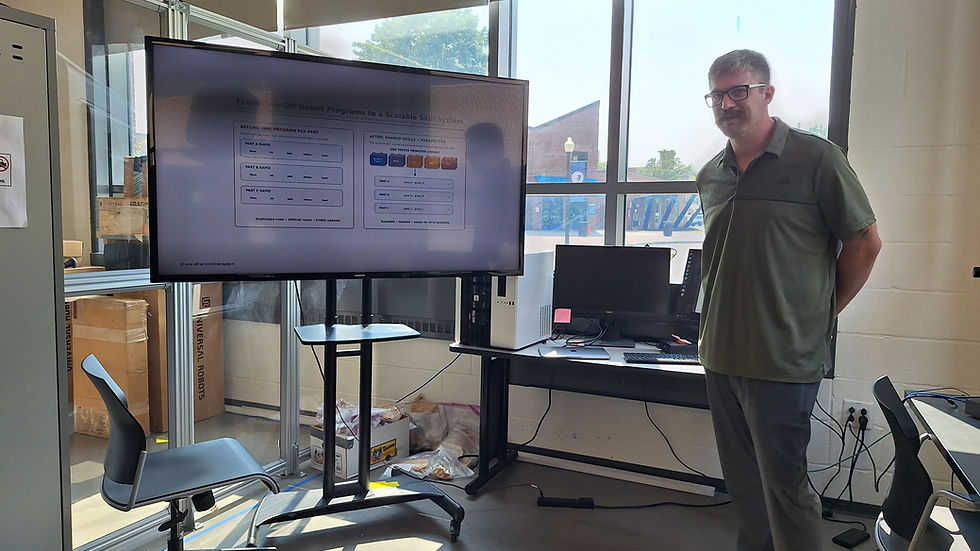
Students from the CT State Community College Asnuntuck campus and Central Connecticut State University formed a collaborative team. Their goal was to create an engineering workflow that is both human-supervised and simulation-validated. This workflow seamlessly connects natural-language process requirements with automation architecture, virtual commissioning, and real-world system integration.
This innovative approach provides a streamlined interface. Here, a process or manufacturing engineer can articulate a desired application. For example, they might want to implement a robotic inspection system using an Allen-Bradley PLC (Programmable Logic Controller) and a Cognex camera. In response, the platform automatically generates a comprehensive Automation System Diagram. This diagram identifies essential components, defines their relationships, and specifies the industrial communication protocols needed for effective operation.

Through this project, students are not only gaining invaluable technical skills but also advancing manufacturing practices by integrating AI technologies. The initiative demonstrates how educational institutions can collaborate with industry leaders and research centers. This collaboration prepares the next generation of engineers and technologists for the challenges and opportunities ahead in the rapidly evolving landscape of manufacturing and robotics.

Professors:
Dr. Haoyu Wang, Central Connecticut State University (CCSU)
Professor Mathew Zamaria, Connecticut State Community College (CT State) Asnuntuck
Students:
Tyler Brown, Daniel Polgun, Rumman Shahzad, and Eldin Bukalo from CCSU
Gregoire Gerard, Aiden McGraw, John Tzoumas, and Chad Holmes from CT State Asnuntuck
National Center for Next Generation Manufacturing team and supporters:
Dr. Karen Wosczyna-Birch, Director and Principal Investigator of the NCNGM
Wendy Robicheau, Assistant Director of the NCNGM
Marco Taverner, Community Engagement Coordinator of the NCNGM
Professor Eric Flynn, CT State Gateway
Andrew Angle, retired high school teacher
Diego Angles, graduate of CT State Manchester, now enrolled at the University of Connecticut (UConn)

The integration of AI into manufacturing education is a vital step toward preparing students for future careers. By engaging in hands-on projects, students develop essential skills that will benefit them in the workforce. This initiative not only enhances their learning experience but also contributes to the advancement of the manufacturing sector. As educational institutions and industry leaders continue to collaborate, the future of manufacturing education looks promising.


Comments